
Annie Butler Sparks a Creative BFF Renaissance in Benson
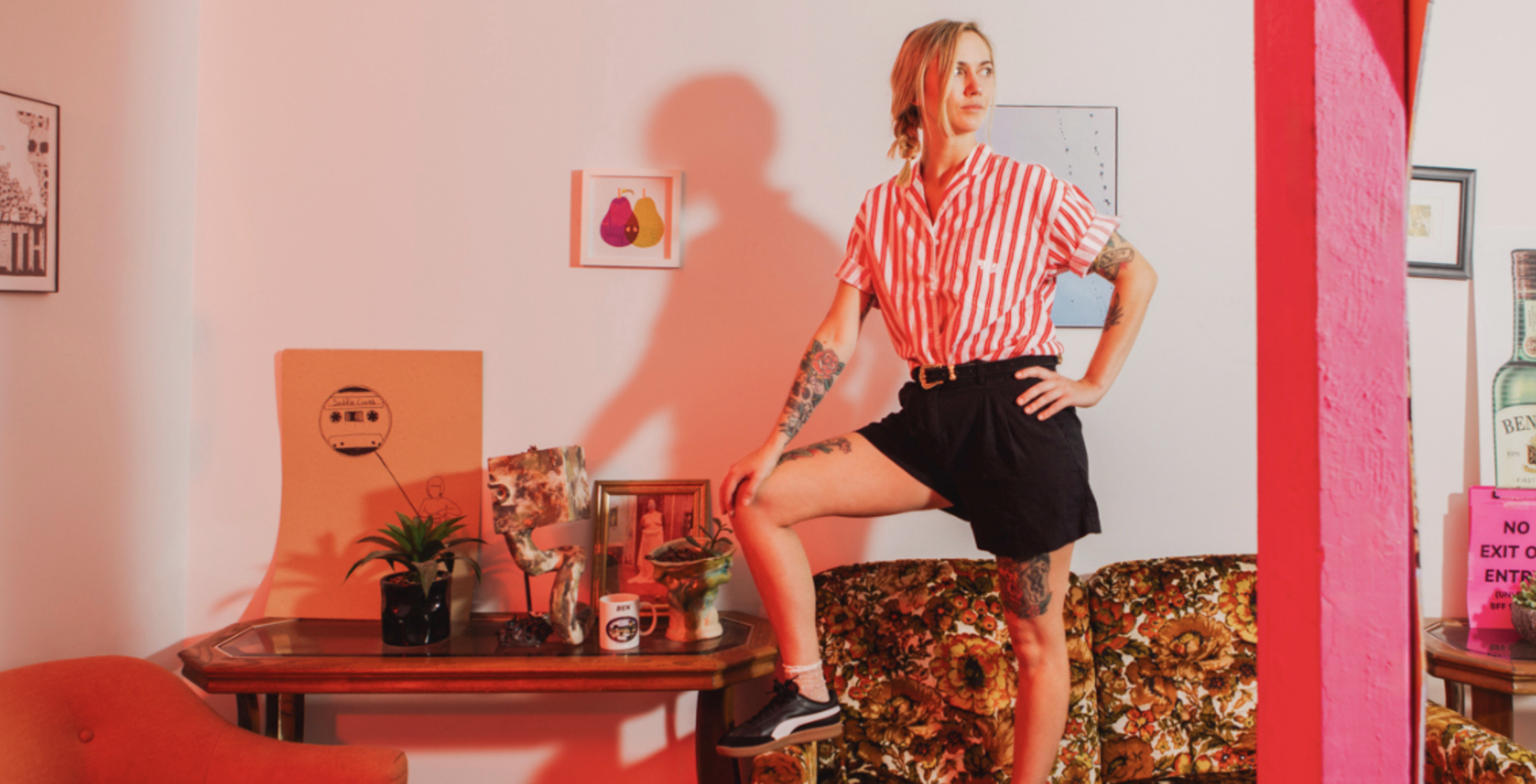

by Andy Williams November 21, 2025
Annie Butler wears many hats as director of the Benson Creative District, but two missions fuel everything she does: sparking community engagement through art and marrying the neighborhood’s grassroots arts scene with economic development.
Both joined forces recently when Butler brokered a deal to transform a Benson backlot while creating opportunities for budding high school artists.
When Athletic Brewing Company granted the Creative District funds to renovate the lot behind the Petshop art studio and gallery by adding gardens, seating, and shade structures, Butler bypassed contractors. She tapped into long-standing relationships at Benson High School and recruited six student interns from the magnet school’s Design and Construction Academy.
These students from Nebraska’s most diverse high school—representing more than 20 native languages—didn’t just meet expectations. They crushed the project, crafting Adirondack chairs, modular bench-and-planter combinations, umbrella stands, and a kids’ mud kitchen.
Butler’s real victory with the project? Deepening bonds between two neighborhood powerhouses and recommending one of the participating students for an Omaha young leader advisory board.
“A lot of times, I feel like the only thing holding someone back from opportunity is not knowing the right people,” Butler said. “When you can make those kinds of connections, you can reach the opportunities. We want to facilitate more connections like that.”
From Street Art to Official Status
This community-first approach has powered Butler’s organization since long before earning official Creative District designation from the Nebraska Arts Council in 2021. The real story started years earlier with a scrappy monthly event that transformed Benson’s streets.
In June 2012, longtime bartenders Alex Jochim and JD Hardy launched “Benson First Friday” (BFF)—an art walk along Benson’s Maple Street strip. With zero traditional galleries in the neighborhood, those early BFFs brought art directly to people: galleries popped up in bars and restaurants, craft shops materialized on sidewalks, fashion shows spilled into the streets, muralists painted live, and DJs provided soundtracks.
“I think even Alex and JD would say they didn’t think about what would happen after that; it was just about getting that first one going,” said Butler, who volunteered for the inaugural BFF as manager of Parlour 1887 salon after experiencing a First Friday in Kansas City. “So we were introducing people to an art gallery who didn’t think they wanted to go to an art gallery by having it in a restaurant or a bar or on the street.”
Benson stalwarts—Jake’s Cigars, Benson Brewery, Ted and Wally’s—jumped aboard early, helping founders and volunteers bootstrap the arts scene mostly out-of-pocket. By 2015, BFF had evolved into a nonprofit producing public art projects, regional outreach, gallery operations, youth programming, and merchandise.
Funding remained tight, forcing the crew to get creative with community impact projects: a pink fake phone booth stocked with tools to spark activist calls to politicians, and MAMO—an art gallery housed in a semi-trailer that can roll into remote areas starved for cultural events.
“There was very little economic activity happening in this neighborhood before we started First Friday, but we weren’t thinking about it like, ‘Ooh, we’re going to drive so many people to the neighborhood and all these businesses are going to pop up,’” Butler explained. “When you’re an artist, a creative, you’re not thinking about the economic implications. But it did draw people and boost the economic vitality of the neighborhood.”
The numbers prove it. Since 2011—the year before First Fridays began—commercial property values within the district have increased an average of 223%. Benson businesses report the monthly events increase sales by 10 to 30% on those Friday nights, and bring an average of 4,000 visitors per art walk. “We’re still amazed by the numbers,” Butler said.
Perfect Platform for Growth
Benson inspired the Arts Council’s Creative District Program, which harnesses the arts as an economic engine to support communities, drive innovation, and unite neighborhoods around creativity. But after navigating an extensive application process—SWOT analysis, comprehensive workbook, community forums—the Benson Creative District designation was Nebraska’s second to be officially certified after Ashland’s Flora District.
“We really were a model because of what we had been doing for years without the designation,” Butler said. “We were trying to figure out the gaps in development in the neighborhood. What do people want to see? And we started to think more broadly about our neighborhood—not only about what art people want, but thinking about a bigger picture.”
Enter Butler with perfect timing. She’d closed her salon after a decade, had a son, and stayed connected to BFF as board member, then president, then advocacy chair. At 29, she’d just earned a sociology degree when Jochim called about the Creative District designation and an open director position.
“This is about community engagement and art? That’s a perfect fit for me,” Butler said. “That’s literally all I’ve been doing—not because I consider myself an artist, I don’t have that creative brain in that way. But to get the things done we want done in a creative district, you need to have relationships with people, and I have 13 years of history under my belt. We’ve already established our relationship and our trust.”
Despite the seamless fit, Butler struggled to believe a passion project could become a paycheck.
“I know everything about BFF, and I know how we got here. I saw us when we had nothing,” said Butler, noting the Creative District’s current staff of three full-time and 34 part-time employees. “So I think it was a shock to my system that this was even a possibility—not because I couldn’t see myself in that position. I just couldn’t believe the position even existed.”
She continued, “I couldn’t imagine that 10 years later, I’m a full-time employee doing something that was this fun for me. It was in my neighborhood. It’s the way that I met people and built my community. What could be better?”
Creative Solutions to Real Problems
Butler and company got busy dreaming bigger and envisioning how art and creativity could tackle community challenges: trash collection (“Can we paint trash cans and gamify it to make it more exciting to throw away your trash?”), traffic flow on Maple (“It’s basically a highway as fast as people drive through here.”), and bicycling infrastructure (“Once bike lanes are in, do they have to be regular green paint? Could we hire an artist to do it?”).
When the City of Omaha recently installed traffic bollards on every Maple Street corner, the Creative District spotted opportunity. “Can the bollards become public art?” Butler said. “Totally makes sense, right?”
But most entities don’t approach infrastructure with artistic vision, so the Creative District focuses energy on efforts they can control: weekly “Green Team” cleanups followed by art workshops, fairy gardens where residents add recycled treasures, and public art installations.
“Like the Green Team cleanups, people just saw us out there and they were like, ‘What are you doing? We want to do that, too,’” Butler said. “A lot of what we do spreads by word of mouth, like going back to pre-social media days. We still have that mentality of staying hyper-local and doing things with input from our staff, our volunteers, and our neighbors.”
Model for the State
The Benson Creative District’s success has ignited a movement. Omaha now boasts Castle & Cathedral and Dundee creative districts, while more than 30 Nebraska communities from Norfolk to Red Cloud, Fall City to Sidney have launched their own.
Butler and her BFF colleagues meet monthly with a Nebraska Creative District cohort, and regularly advise newcomers who received the same $10,000 startup grant. But Butler emphasizes how little that initial funding accomplishes without strong community partnerships like those cultivated in Benson. She often guides visiting creative district leaders through Benson First Friday, showcasing the art of the possible.
“We try to help them see that this designation puts you in a position to collaborate with others in your community,” Butler said, highlighting Benson’s arm-in-arm spirit. “And we show them simple ways they can get started in their community. Something like First Friday is a good jumping-off point, or like this office with artwork in the window. You’re all working toward this shared goal of boosting the economic vitality of your community utilizing the arts. That’s a great starting point.”
Future Connections
Building on current momentum, Butler and company are crafting a future rich with creative connections—like the newly launched landscaping company that didn’t just design and build garden beds on their property, but created an innovative dye garden using plants that produce natural dyes. The group is developing a neighborhood website and newsletter designed by artists, exploring wayfinding signage painted by artists, a public art database, and a brochure guiding visitors through walking tours of district art and creativity.
“I feel like my job is really to be a liaison and try to figure out what everyone is doing, and how I can connect the right people and the right organizations for who’s doing what,” Butler said, “so that we’re not all working in silos, and we can work more efficiently and effectively. We’re working on basic stuff in the way we’ve always done it, which is just a little bit weirder than everyone else, but is very much who we are.”
Visit bffomaha.org for more information.
This article originally appeared in the November/December 2025 issue of Omaha Magazine. To receive the magazine, click here to subscribe.